Thursday, 19 December 2013

Questionairre

For our thriller sequence we wanted to find out what our peers wanted to have if they saw our thriller. So we asked them questions on what they would like to see in our Psychological Thriller.

The questions are as follows:


- Do you want to see blood? (Closed Question)
- What kind of character would you like to portray the killer? (Closed Question)
Man, woman, child or old man
- What would you like to see in a psychological thriller? And why (Probe question)
- What sort of location do you prefer? (Closed Question)
Inside or outside
- Murder Weapon (Closed Question)
Knife, gun, rope, just hands or neither seen nor heard
- What sounds would you associate with a thriller? (Open question)
- Would you associate music with an opening of a thriller? If so what kind? (Probe question)


Tuesday, 17 December 2013

Monday, 16 December 2013

Preliminary Task Review

How many mistakes did you make?
We made a huge error, of not filming the best take of one side of a conversation.  However while editing we were able to recover what is said.


How did you manage the group dynamics and collaborative nature of film-making?
By using actors, in our group we were able to both be camera operator and director, whilst filming. And we also both took turns when editing the film.


How did you manage the equipment?
The camera equipment was occupied the whole filming process, and each person of our group took charge of the equipment at different times. 

How did you manage the deadline?
We did our filming and editing in a relatively good time scale. We took only 2 hours to film and then edit the whole task.


Were there any health and safety logistical problems?
In our scene we didn’t do any stunts, we were also filming in a child friendly place of a school.
So we did not have to go through any risk assessments.


How did you organise your human resources?
a)      Actors – We assigned the actors roles at the start of the filming process. We then had to direct them in the filming process.

b)      Costumes – We organised the costumes, by telling our actors to come dressed casual, as though you are just at a normal day in school.

c)       Props – The only major prop that was used in filming was the doors. We organised it by choosing if they were going to be open or closed before shooting.

How did you manage your cameras?
We managed our cameras, by looking after them all the time. We also only allowed trained people to work on the cameras.


How did you manage your lighting?
We managed our lighting by using only natural lighting during the walking scene in the corridor. And then used the red heads reflected off walls in the Suite to create an ambience.


How did your storyboarding and shooting script work in practise?
We didn’t change much from the original plan, but by the time we realised we didn’t shoot one scene it was too late, we would have had to shoot that scene all over again, and it is very hard to do because of continuity reasons, such as the actors must wear the same costumes.
The outcome of this happening meant that the speaking section had to be cut short, but we did recover it in editing.


How successful were you in managing your time?
We were very successful in managing our time, as we did it very quickly.


How did digital technology enable you to develop creatively?
Digital technology enabled us to develop creatively, using the camera equipment we able to adjust the iris controls, which determines how much light comes in, we could use the focus pull, to adjust the depth of field, and use the zoom to zoom into the subject without moving.
During the editing process, we could use the razor tool in Adobe Premiere too cut the film, and then stick the two shoots together.

In filming and editing, how did you ensure that the meaning would be apparent to the audience?
We used light tones, and high key lighting to show that this scene isn’t meant to make the audience be in fear, it is just meant to be a meet up of two students from school.
In editing we reduced harsh sounds and lighting that was produced during the filming process. And also cut out parts when other people accidently walked into our shot.


What type of people have you represented in your piece?
We wanted to represent young kids at school, which have no time to have a conversation.
We wanted a real type of conversation almost not scripted but would have happened in normal day life, we also wanted it to be kind of awkward when they finished talking.


What sort of realism have you constructed?
We wanted to have a natural conversation, and had to be cut really short otherwise it would take up too much time.


What role do the micro elements play in the construction of verisimilitude?
The mise-en scene, acting, dialogue and style of camerawork, are all used to focus on the realism of school life we wanted to portray in the macro level of the textual world.

Thursday, 5 December 2013

Lighting

We had a Lighting Workshop, where we learnt how to use lighting effectively in our pieces


The professional taught us that any light can be used for the actual light, and also that the 3 Point Lighting: Key, back and filler lights are usually the same kind of lamp.
In our lesson we used the schools ‘redheads’ to show us the difference that the light makes.
He showed us that we can use walls and ceilings to bounce the light, and also use a reflector to give a softer light feel.
Natural light is light blue; however artificial light is usually orange. To make the scene feel more natural we used a filter that was coloured a pale blue.
For Film Noir (French for “Black Film”), the lighting should be Low Key Lighting, which accentuates the contours of an object by throwing areas into shade while a fill light or reflector may illuminate the shadow areas to control contrast.

Key Words:
Key light – Usually the brightest and the most influential
Back light – Helps counteract the effect of the key light, thus making the character/object look more ‘rounded’
Filler light – Helps to soften the harsh shadows that the use of key and back lights creates. There may be more than one filler light.

Friday, 29 November 2013

What is your Favourite Type of Thriller Film?

We posed this question to a few pupils in our year, and these were the outcomes


We used the most frequent answers from the people interviewed in this video, and placed them in the Poll using KwikSurveys.


Along with the Poll, we concluded that a Psychological Thriller would be the best choice of Sub Genre for our assessed work.

Poll - KwikSurveys

To advertise this poll to more people I published a link on Facebook, so that people that we didn't interview can still have a say. And also give us feedback, such as offering us other suggestions of thriller ideas, in the 'other' section of the poll.

To view the Results of this poll, please press the 'View Results' button at the bottom of the embedded window.
What is your Favourite type of Thriller ?
Crime0%
Psychological0%
Supernatural0%
Spy0%
Other: (Please specify)0%

Suspense Clips

In class we researched suspense clips to help us with our thriller ideas; they consisted of the opening titles, which we will need to make for our first task.

White of the Eye (1987) Donald Cammell

The titles starts with eagles flying, and Extreme Close Up of the eagles eyes, which dissolves into the killers’ eyes, making the viewer feel that the killer, like the bird, is hunting for its prey.
The music also adds to the mystery by putting the viewer on edge, with Non-Diegetic sounds
The lighting of the extract is very bright, as it is shot in the day. This makes the audience sense that what is going to happen, could happen to them.
The camera turns to a hand held camera, this make the audience feel more like the character, and feel like they are part of the film.
The audience is given more information than the victim; the burglar is in the home. This is a Hitchcock technique used in many of his films.

The Big Heat (1953) Fritz Lang

The use of Non-Diegetic sound, orchestrated music, adds to tension.
The woman reacted more with the inspector, than she did talking to the other man after the shooting, demonstrating that she can hold emotions or doesn't have any feeling towards her husband, she called herself the ‘widow’ straight after the death.
Spotlight is focused on the gun, and you can also see his sheriff badge. The highlighting of props puts the scene into perspective and gives a plotline.
There is an Over the Shoulder shot of the man killing himself, the viewer doesn't see the full gory details of the killing, as it is left to their imagination, this is due to the strict rules on what could be shown back then. This regulation of what can be seen is called the Hays Code.

Psycho (1960) Alfred Hitchcock

[Music and Soundtrack – Bernard Herrmann]

Rain on car window and wipers going past, puts you in the perspective of driving the car, and adds to the realism. There is only Diegetic sound at this point emphasizing the rain, and hints to the viewer that this isn't going to be a happy kind of movie.
The camera is at a Low Angle on Mr Bates, showing that he has power, as using this low angle technique makes them seem bigger and taller.
Mr Bates moves further back from the frame when he clams down; showing that he has a split personality, this technique is used well to emphasize this point.
The young woman looks into the mirror, this shows duplicity and that she has different thoughts.
The use of Voyeurism, puts the viewer in Mr Bates perspective of him peeping on women, sharing the mans view.
The music starts after dialogue ends; the music is very high pitch contrasting with the slow pace and ambience of the scene, this contrapuntal use of sound then finds its purpose as the killer is seen lurking behind the curtains and the killing is synchronised with the soundtrack.
Worms eye view of looking at the shower, this clip is used twice, adding to the realism and brings the audience closer the film.
The viewer is not shown much gore nor any nudity of the woman, this is because of the Hays Law, and even what Hitchcock did show, was very controversial at the time.
The part where the blood is seen going down the drain pipe is copied by other directors in films made later on.
Hitchcock was one of the first directors to demonstrate a real thriller, by trying to push the boundaries of film making of that time. I feel that without him doing so, films would never be up to our standards these days.

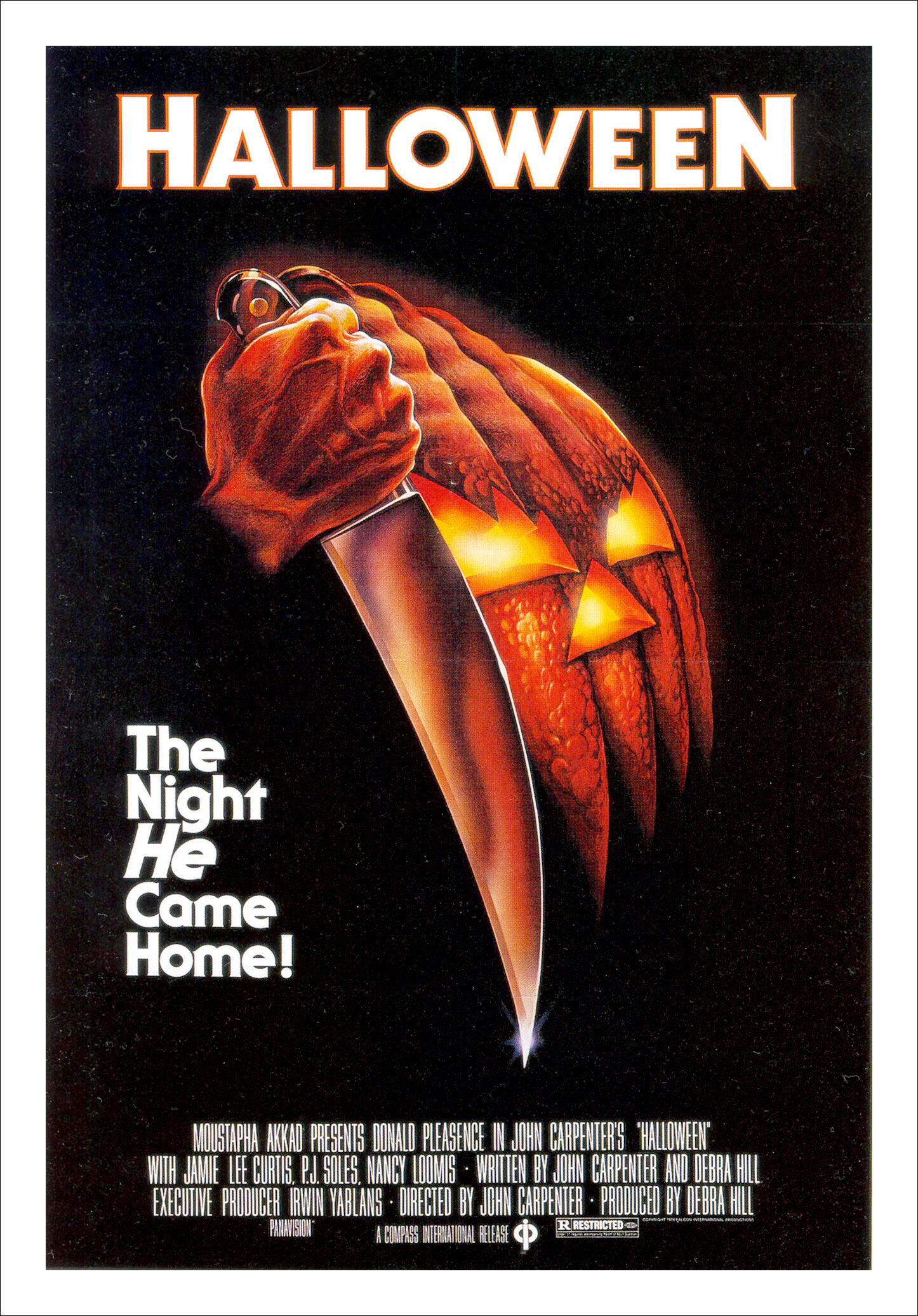
Halloween (1978) John Carpenter


The use of children singing at the start of the film contrasts of innocence, and that there is a false sense of security.
Most of this scene is shot from eye level, using a hand held camera, this pus the audience into the characters perspective. The killer puts on a mask, and this is shown by viewing only through eye holes.
Where the killer is seen peering through the window and where the girl is undressing, gives a sense of the characters nature. This use of voyeurism links up the point of view of the camera.
The colours of the sequence is very dark and blue is prominent, blue is associated with cold colours.
When the light goes off, indicating that the teenagers are doing something. A high pitch screechy sound is heard, indicating the killer is annoyed and frustrated by this.
There is a false shock, as the viewer is shown the boyfriend and we think that the killer would murder him, but then hides in the dark and goes up the stairs.
The clock striking adds a gothic mood.
The woman singing before she is going to be murdered, couples with the children singing, showing innocence.
When the killer is revealed at the end of the titles, the viewer is shocked that he is a child.

Reservoir Dogs (1991) Quentin Tarantino

The camera doesn't show Mr Blonde cutting his ear off, this leaves the viewer to think about it themselves.
The camera follows Mr Blonde to the car, where he picks up the oil can. The audience sees more than the victim.
An upbeat song is played, when Mr Blonde is cutting off his ear. This contrapuntal use of music adds humour to the extract and this is also a Cathartic experience, this brings the intensity of what is going on in the scene down, and getting rid of intense emotions. The music isn't heard when he leaves the room, but does start again when he returns, showing that the viewer is supposed to follow that character.
The viewer would be shocked by the character that they are following has now been shot. This sense of not having the protagonist win, leaves the viewer on edge all the time, as they don't know what could happen.

Thursday, 28 November 2013

Introduction

Hello, my name is Leon, I like watching comedy and family films, and I am partial to a good action thriller, I cannot bare watching any horror movies, as they seem to realistic and go too far. I also watch numerous television shows, and I also love my music. So I thought that this course would be great for me.

I know that in this year I’ll be making the start to a thriller movie, I am excited to see how the film process works and how all different elements, such as mise en scène, lighting, editing and camera work have to fit into the content of the genre. In the second year of this course we will be making a music video, and I am really excited to shoot that, and I am already thinking of ideas.

I have never done any type of Media Work prior to picking media for A Level, but I do find the subject very interesting in how movies are made and the time and effort every single piece of Media work takes to make a great piece.