In class we researched suspense clips to help us with our thriller ideas; they consisted of the opening titles, which we will need to make for our first task.
White of the Eye (1987) Donald Cammell
 The titles starts with eagles flying, and Extreme Close Up of the
eagles eyes, which dissolves into the killers’ eyes, making the viewer feel
that the killer, like the bird, is hunting for its prey.
The titles starts with eagles flying, and Extreme Close Up of the
eagles eyes, which dissolves into the killers’ eyes, making the viewer feel
that the killer, like the bird, is hunting for its prey.
The music also adds to the mystery by putting the viewer on edge,
with Non-Diegetic sounds
The lighting of the extract is very bright, as it is shot in the
day. This makes the audience sense that what is going to happen, could happen
to them.
The camera turns to a hand held camera, this make the audience feel
more like the character, and feel like they are part of the film.
The audience is given more information than the victim; the burglar
is in the home. This is a Hitchcock technique used in many of his films.
 The Big Heat (1953) Fritz Lang

 The use of Non-Diegetic sound, orchestrated music, adds to tension.
The woman reacted more with the inspector, than she did talking to
the other man after the shooting, demonstrating that she can hold emotions or
doesn't have any feeling towards her husband, she called herself the ‘widow’
straight after the death.
Spotlight is focused on the gun, and you can also see his sheriff
badge. The highlighting of props puts the scene into perspective and gives a
plotline.
There is an Over the Shoulder shot of the man killing himself, the
viewer doesn't see the full gory details of the killing, as it is left to their
imagination, this is due to the strict rules on what could be shown back then.
This regulation of what can be seen is called the Hays Code.
Psycho (1960) Alfred Hitchcock
[Music and Soundtrack – Bernard Herrmann]
 Rain on car window and wipers going past, puts you in the
perspective of driving the car, and adds to the realism. There is only Diegetic
sound at this point emphasizing the rain, and hints to the viewer that this
isn't going to be a happy kind of movie.
Rain on car window and wipers going past, puts you in the
perspective of driving the car, and adds to the realism. There is only Diegetic
sound at this point emphasizing the rain, and hints to the viewer that this
isn't going to be a happy kind of movie.
The camera is at a Low Angle on Mr Bates, showing that he has power,
as using this low angle technique makes them seem bigger
and taller.
Mr Bates moves further back from the frame when he clams down;
showing that he has a split personality, this technique is used well to
emphasize this point.
The young woman looks into the mirror, this shows duplicity and that
she has different thoughts.
The use of Voyeurism, puts the viewer in Mr Bates perspective of him
peeping on women, sharing the mans view.
The music starts after dialogue ends; the music is very high pitch
contrasting with the slow pace and ambience of the scene, this contrapuntal use
of sound then finds its purpose as the killer is seen lurking behind the
curtains and the killing is synchronised with the soundtrack.
Worms eye view of looking at the shower, this clip is used twice,
adding to the realism and brings the audience closer the film.
The viewer is not shown much gore nor any nudity of the woman, this
is because of the Hays Law, and even what Hitchcock did show, was very
controversial at the time.
The part where the blood is seen going down the drain pipe is copied
by other directors in films made later on.
Hitchcock was one of the first directors to demonstrate a real
thriller, by trying to push the boundaries of film making of that time. I feel
that without him doing so, films would never be up to our standards these days.

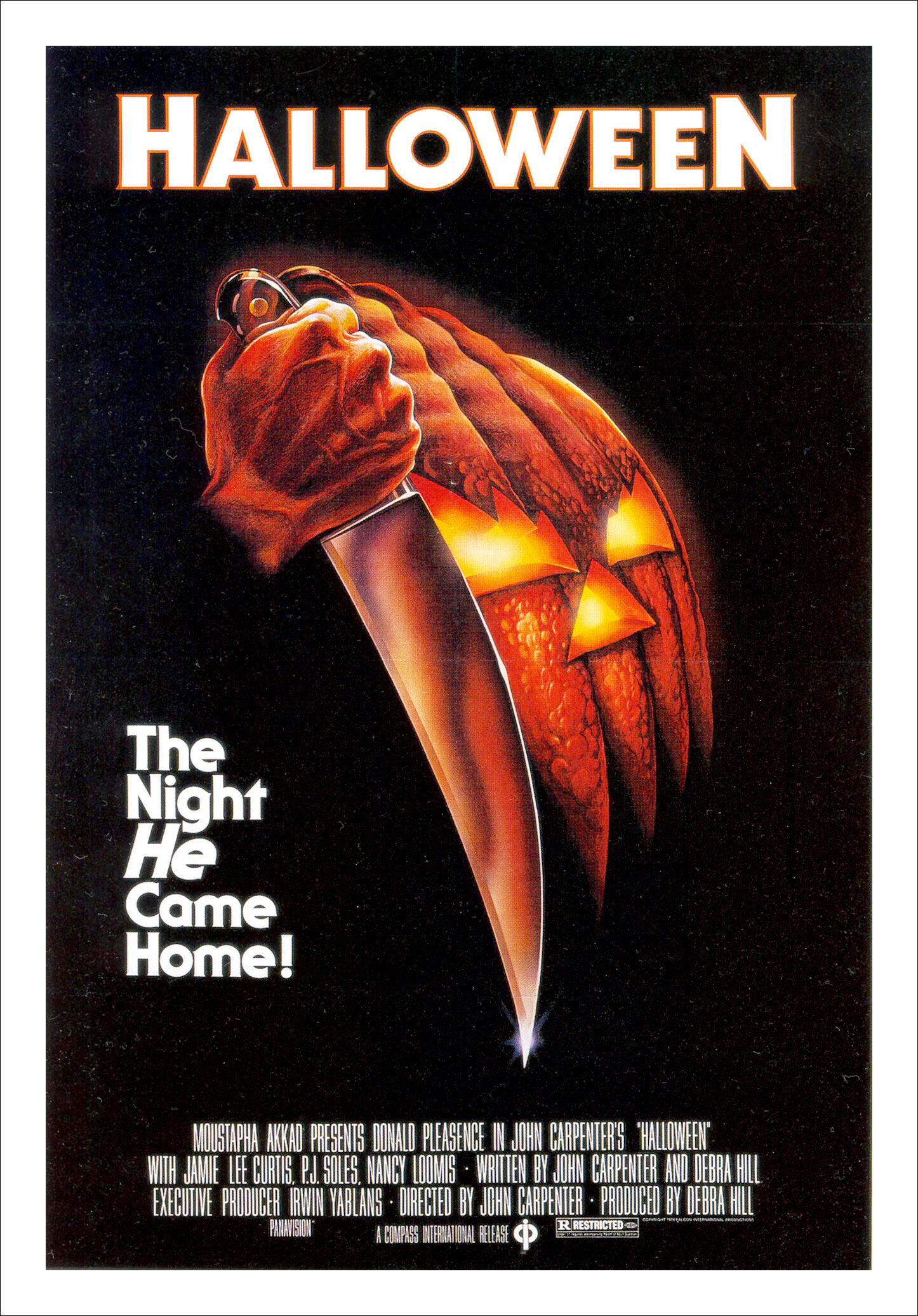
Halloween (1978) John Carpenter
 The use of children singing at the start of the film contrasts of
innocence, and that there is a false sense of security.
The use of children singing at the start of the film contrasts of
innocence, and that there is a false sense of security.
Most of this scene is shot from eye level, using a hand held camera,
this pus the audience into the characters perspective. The killer puts on a
mask, and this is shown by viewing only through eye holes.
Where the killer is seen peering through the window and where the
girl is undressing, gives a sense of the characters nature. This use of
voyeurism links up the point of view of the camera.
The colours of the sequence is very dark and blue is prominent, blue
is associated with cold colours.
When the light goes off, indicating that the teenagers are doing
something. A high pitch screechy sound is heard, indicating the killer is
annoyed and frustrated by this.
There is a false shock, as the viewer is shown the boyfriend and we
think that the killer would murder him, but then hides in the dark and goes up
the stairs.
The clock striking adds a gothic mood.
The woman singing before she is going to be murdered, couples with
the children singing, showing innocence.
When the killer is revealed at the end of the titles, the viewer is shocked
that he is a child.

Reservoir Dogs (1991) Quentin Tarantino
 The camera doesn't show Mr Blonde cutting his ear off, this leaves
the viewer to think about it themselves.
The camera doesn't show Mr Blonde cutting his ear off, this leaves
the viewer to think about it themselves.
The camera follows Mr Blonde to the car, where he picks up the oil
can. The audience sees more than the victim.
An upbeat song is played, when Mr Blonde is cutting off his ear.
This contrapuntal use of music adds humour to the extract and this is also a
Cathartic experience, this brings the intensity of what is going on in the
scene down, and getting rid of intense emotions. The music isn't heard when he
leaves the room, but does start again when he returns, showing that the viewer
is supposed to follow that character.
The viewer would be shocked by the character that they are following
has now been shot. This sense of not having the protagonist win, leaves the
viewer on edge all the time, as they don't know what could happen.


Lots of relevant observations. Please highlight key words. SG
ReplyDelete